- 💭 She Got a Rash. I Got Curious.
- ⚡ Quick Verdict: Who This Exfoliant Is For
- 💡 Texture & Feel: What a Daily Chemical Exfoliant Actually Feels Like
- 💪 Visible Effects: Dullness, Pores & Texture Over Time
- 🧪 Ingredients: Why Five Acids and Why This Gentleness Makes Sense
- 🗣️ Real Voices from Real Users
- ❓ Common Questions About Obagi Peeling V10 Essence
- ✨ Where to Buy Obagi Peeling V10 Essence
- 📎 Reference
💭 She Got a Rash. I Got Curious.
A friend of mine tried a chemical exfoliant last year. Not an aggressive one — nothing with a percentage that would make a dermatologist wince. A reasonably well-reviewed acid toner, the kind that shows up on every “glass skin routine” list. By day three, her cheeks were red. Not flushed. Red. She stopped, her skin recovered, and she decided that acids simply weren’t for her.
I didn’t think she was wrong, exactly. But I did think she might have picked the wrong product. Because “chemical exfoliant” covers a lot of ground — from the kind that requires a neutralizer and a recovery week, to the kind that’s designed for use twice a day on skin that isn’t already angry. These are not the same thing, and the beauty industry doesn’t always make that distinction clearly.
The Obagi Peeling V10 Essence sits firmly in the second category. It’s a wipe-off essence, not a peel in the clinical sense. It contains five acids, none at concentrations that would cause a reaction in most people. It’s designed for morning and evening use, starting from day one. When I first read that on the box, I was skeptical in the way you get skeptical when something sounds too convenient. So I went and looked at the formula.
Here’s what I found.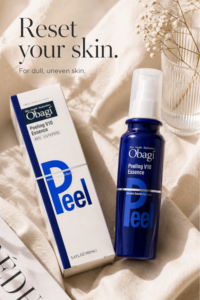
⚡ Quick Verdict: Who This Exfoliant Is For
This is the right product if:
- Your skin looks dull, feels rough, or has uneven texture you can’t shift with cleansing alone
- You’re new to chemical exfoliants and want a gentle, low-risk starting point
- You’ve been put off acids before due to stinging, redness, or over-drying
- You have oily, combination, or normal skin with congestion or enlarged pores
- You want something you can use daily — morning and evening — without building up to it
- You live in a humid climate where dead skin buildup contributes to clogged pores and dullness
You can skip this if:
- You’re looking for a high-concentration AHA/BHA treatment for active acne or deep scarring
- You already use a prescription retinoid or strong acid — layering may cause over-exfoliation
- Your skin is currently compromised, sensitized, or recovering from a reaction
- You want visible peeling or intense resurfacing results — this formula is too gentle for that
- You have very dry or eczema-prone skin — the formula suits oily to normal best
💡 Texture & Feel: What a Daily Chemical Exfoliant Actually Feels Like
The first thing that surprises people is the texture. The name “peeling essence” suggests something clinical — a thin, sharp-smelling liquid that tingles the moment it touches your face. This isn’t that. The formula is slightly viscous, somewhere between a light serum and a toner, with a faint citrus scent that fades quickly. On a cotton pad, it spreads evenly without soaking through immediately, which makes application more controlled than a lot of watery acid toners.
Applied to the face — wiped gently across cheeks, forehead, nose, and chin — it absorbs without residue. There’s no tightness afterward, no tingling for most users, and no film. Skin feels slightly smoother immediately, in the way freshly cleaned glass feels different from glass that’s been sitting for a while. The difference is subtle on day one. It compounds over time.
What’s notably absent: the burn. Users who have experienced stinging from other acid products consistently report that this one doesn’t do that. The low acid concentrations and the buffering effect of the humectant-heavy base mean that even first-time users typically tolerate it without issue. That’s not an accident — it’s the point of the formula.
One practical note: this is a wipe-off product, not a rinse-off. You apply it to a cotton pad, swipe it across your face, and move on to the rest of your routine. No waiting, no rinsing. The cotton itself does some of the mechanical work — lifting off the dead cells that the acids have loosened. Using a large, soft cotton pad (rather than a small or rough one) makes a noticeable difference in how the application feels.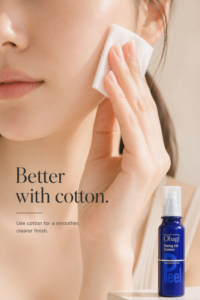
💪 Visible Effects: Dullness, Pores & Texture Over Time
Somewhere around day four or five, skin stops feeling rough in the morning. Not dramatically — you wouldn’t photograph it — but you notice it when you apply moisturizer and it spreads differently. That’s usually the first sign. There’s no purging phase, no adjustment period, no “it gets worse before it gets better” arc. The dullness that comes from accumulated dead skin — the flatness that moisturizer never quite fixes — just quietly starts to lift.
For oily and combination skin types, the pore-congestion improvement tends to be the most noticeable change. Blackheads on the nose and chin become less pronounced over two to four weeks of consistent use. This isn’t the same as pore-minimizing — pore size doesn’t actually change — but when the buildup inside them clears, they catch less light and appear smaller. It’s a maintenance effect rather than a treatment effect, which means it requires consistency to sustain.
Users in humid climates — Singapore, Malaysia, parts of the US South — frequently report that this product performs particularly well for them. Humidity accelerates dead skin accumulation and contributes to the kind of low-grade congestion that makes skin look perpetually uneven. A gentle daily exfoliant addresses that accumulation without the barrier disruption that stronger acids can cause in already-stressed skin.
Brightening is real but gradual. Most users notice it around the three to four week mark — an evenness to the skin tone, a slight reduction in post-blemish marks, a quality that’s hard to name but easy to recognize. Japanese skincare tends to prioritize this kind of incremental, sustainable result over dramatic short-term transformation, and this product is very much in that tradition.
⚠️ Not the best fit if…
- You’re expecting clinical-level resurfacing — the acid concentrations are low by design, and the results reflect that
- You’re treating active inflammatory acne — this will help with texture and congestion but isn’t formulated for acne treatment
- You want immediate, visible results — this is a slow-build product; the payoff requires patience and consistency
🧪 Ingredients: Why Five Acids and Why This Gentleness Makes Sense
Obagi in Japan occupies an interesting position. The brand shares its name with a medical-grade skincare line used in clinical settings — and while the consumer Obagi products sold in Japanese drugstores are separate from that medical range, the association carries a certain weight in Japan. Consumers familiar with the brand expect formulas that are designed with some rigor, not just marketing language. The V10’s five-acid approach is where that expectation either pays off or doesn’t.
Here’s what’s actually in it, and why it matters. The five acids — glycolic, lactic, citric, gluconic, and phytic — are present at concentrations low enough to use daily, but chosen deliberately for what each one does at the molecular level. Glycolic acid has the smallest molecular size of the AHAs, meaning it penetrates the deepest into the stratum corneum. Lactic acid is larger and works closer to the surface, while also functioning as a humectant — it pulls water into the skin rather than simply exfoliating it. Citric acid contributes to pH balance and adds mild brightening. Gluconic acid, a polyhydroxy acid, is the gentlest of the group — it exfoliates but also has antioxidant properties and is well-tolerated even by sensitive skin. Phytic acid rounds out the blend with mild brightening and antioxidant action.
What stopped my skepticism was this: the five acids aren’t interchangeable. They’re different sizes. Glycolic is small enough to go deep; gluconic is large enough to stay near the surface. Used together, they cover the full depth of the stratum corneum in a single application — which is why twice a day works without compounding irritation. The “V10” isn’t ten acids. It’s one formula working at ten layers.
The rest of the formula is built around not undoing that work. Sodium lactate is a humectant that keeps moisture in while exfoliation is happening. Squalane adds barrier support. The overall pH is kept low enough for the acids to be active, but not so low that the formula becomes aggressive. It’s a balancing act, and the fact that this product is consistently described as non-irritating in independent reviews suggests it’s been calibrated carefully.
| Ingredient | Role | Why It’s Here |
|---|---|---|
| Glycolic Acid | AHA (small molecule) | Deepest penetration of the five — loosens dead skin cells from within |
| Lactic Acid | AHA + humectant | Exfoliates at the surface while drawing moisture in — gentler than glycolic |
| Citric Acid | AHA + pH adjuster | Mild brightening, helps maintain the formula’s active pH range |
| Gluconic Acid | PHA (large molecule) | Gentlest exfoliant of the five — antioxidant properties, well-tolerated by sensitive skin |
| Phytic Acid | Natural acid + antioxidant | Mild brightening and anti-inflammatory; helps with post-blemish marks |
| Sodium Lactate | Humectant | Retains moisture during exfoliation — key to why this doesn’t over-dry |
| Squalane | Emollient | Barrier support — prevents transepidermal water loss post-exfoliation |
| Vibrio Alginolyticus Ferment Filtrate | Marine ferment | Skin-conditioning and hydration-support; adds a layer of care to the active formula |
Full ingredient list: Water, Sodium Lactate, DPG, BG, Mineral Oil, Squalane, (Acryloyldimethyltaurate Ammonium/VP) Copolymer, Lactic Acid, Phytic Acid, Glycolic Acid, Gluconic Acid, Citric Acid, Vibrio Alginolyticus Ferment Filtrate, Hydrogenated Lecithin, Batyl Alcohol, Glyceryl Stearate, PEG-60 Hydrogenated Castor Oil, Cholesterol, Fragrance. Source: YesStyle / Ichiban Mart product listings. Verify against current packaging.
🗣️ Real Voices from Real Users
“I’ve tried stronger AHA toners before and always had to stop because of irritation. This one I’ve been using every day for two months and my skin has never reacted. The texture improvement was slow but it’s real — my foundation goes on completely differently now.”
— Combination skin, previous acid sensitivity. US.
“I was skeptical about the twice-daily thing. It seemed like a lot. But I tried it and nothing happened — in a good way. No redness, no peeling, no adjustment period. Three weeks in my pores on my nose are noticeably less congested. It’s become a non-negotiable part of my routine.”
— Oily skin, congested nose area. Singapore.
“I bought this after a harsh exfoliant left my cheeks irritated for a week. The difference is dramatic. This feels like it’s doing something but never punishing you for it. My skin tone has evened out and I’ve stopped reaching for heavy coverage.”
— Post-reaction recovery, uneven skin tone. Malaysia.
Voices sourced from international retailer reviews and regional beauty community feedback. Edited for length and clarity.
❓ Common Questions About Obagi Peeling V10 Essence
Can I really use this twice a day?
Yes — and that’s genuinely what it’s designed for. The acid concentrations in the V10 are low enough that twice-daily use doesn’t cause the cumulative irritation you’d get from stronger exfoliants. The humectant-heavy base also means the formula is actively replacing moisture as it exfoliates. That said, if you’re using other active ingredients — retinoids, high-percentage vitamin C, or another exfoliant — factor those into how much acid your skin is receiving overall. The V10 is gentle, but it’s not nothing.
Is this suitable for sensitive skin?
More so than most chemical exfoliants, yes. The inclusion of gluconic acid (a PHA) and phytic acid means part of the exfoliation happens at the surface level rather than penetrating deeply, which is gentler on reactive skin. Independent ingredient analysis rates this formula as medium irritation potential — lower than most AHA toners. Users who’ve had reactions to other acids consistently report tolerating this one. If your skin is currently compromised or actively flaring, wait until it’s calm before introducing any exfoliant.
How is this different from a regular toner or essence?
A regular toner hydrates or balances pH. A regular essence focuses on targeted treatment — brightening, firming, or hydration. The V10 is specifically an exfoliating essence: its primary job is removing dead skin cells and improving cell turnover. It’s used after cleansing and before everything else in your routine, because removing the dead skin layer first allows subsequent products to absorb more effectively. Think of it as preparation rather than treatment.
Do I need to use sunscreen with this?
Yes — full stop. AHAs remove the outermost layer of dead skin, which means your skin is more exposed to UV damage afterward. Using this in the morning without SPF would undo a meaningful part of what you’re trying to achieve. SPF 30 or higher, daily, non-negotiable.
How long before I see results?
Texture: within the first week, often sooner. Pore congestion and tone evenness: two to four weeks. Post-blemish marks: six to eight weeks, sometimes longer. This is a maintenance product — the results don’t arrive and stay on their own. They’re sustained by continued use. That’s either a reason to commit or a reason to pick something else, depending on how you feel about routines.
✨ Where to Buy Obagi Peeling V10 Essence
The Obagi Peeling V10 Essence is a Japan-domestic product — it’s not sold in Western pharmacies or mainstream beauty retailers. Below are the options that ship reliably internationally, with notes on which makes most sense depending on where you are.
🌍 International / US — YesStyle
The most straightforward option for US readers and international orders. Fully English interface, USD pricing, and ships to most countries. A good choice if you want to combine with other Japanese or Korean beauty purchases in one order.
🇸🇬 Singapore — LOLO JAPAN on Shopee
For Singapore readers, the most direct route. My friend Maco sources authentic Japanese products and ships locally via Shopee SG — no international shipping wait, no customs uncertainty.
🇲🇾 Malaysia — LOLO JAPAN on Shopee
Malaysia readers can find LOLO JAPAN on Shopee MY — authentic Japanese products shipped directly, with local delivery convenience.
🇯🇵 Japan Domestic Price — Rakuten ROOM
Browse the Japanese retail listing for reference pricing. Pair with Rakuten Global Express (below) to ship internationally.
🌐 Ship from Japan — Rakuten Global Express
Order from Japanese retailers at domestic pricing and consolidate international shipping. Ships to the US, Malaysia, and many more countries. English interface available.
Visit Rakuten Global Express →

💡 New to Rakuten Global Express? Start here — the English-language interface walks you through the process step by step.
📎 Reference Price: Japanese domestic retail price approximately ¥4,400–¥5,000 (180ml). International pricing varies by retailer and shipping.
📎 Reference
- Obagi Peeling V10 Essence Official Page — obagi.co.jp
- Ingredient analysis — What’s In My Jar (WIMJ)
- Full ingredient list — Ichiban Mart
- YesStyle listing — Obagi Peeling V10 Essence on YesStyle
コメント