- 💭 The Step I Had Been Skipping
- ⚡ Quick Verdict: Who This Lineup Is For
- 💡 Step 1 — Cleanse: Powder Wash vs Powder Wash DP
- 💪 Step 2 — Treat: Clear Advanced Lotion for Radiance & Even Tone
- 🌟 Step 3 — Lock In: Serum Gel for Pores, Texture & Hydration
- 📊 The Obagi C Lineup: What Each Product Actually Does
- 🧪 Ingredients: Why This Lineup Uses More Than One Form of Vitamin C
- 🗣 Real Voices from Real Users
- ❓ Common Questions About Obagi C Skincare
- ✨ Where to Buy Obagi C Skincare Products
- 📎 Reference
💭 The Step I Had Been Skipping
There’s a particular kind of frustration that comes with doing everything right and still not seeing results. The serum. The SPF. The double cleanse. The consistent routine. And yet — in the mirror, the same pores. The same texture. The same low-level dullness that no amount of “glow” products seems to touch.
I know this feeling because I had it for a while. And I suspect I’m not alone.
What changed things for me wasn’t a new serum. It was a routine post I stumbled across that reframed something I thought I already understood. The person wasn’t talking about a vitamin C serum at all. They were talking about starting vitamin C at the cleansing step — and building from there. The cleanser already had it. The toner reinforced it. The moisturizer sealed it in.
I had been thinking about vitamin C as one decision: pick a serum, apply at step three, done. Turns out it can be a thread that runs through an entire routine. Which, honestly, made me reconsider what I thought I knew — and sent me down a fairly long rabbit hole into the Obagi C skincare lineup.
This article is what I found. Not a sales pitch for the full system — more of a map for figuring out which part of it actually makes sense for your skin.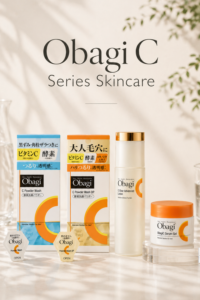
⚡ Quick Verdict: Who This Lineup Is For
✅ Worth exploring if you:
- Have persistent pore congestion, dullness, or uneven texture that single-product routines haven’t shifted
- Live somewhere warm and humid — the kind of climate where pores feel perpetually busy
- Want vitamin C working at multiple steps, not just one
- Are in your late 20s to 40s and noticing your pores look different than they used to — less congestion-related, more… structural
- Prefer a system approach over hunting for individual hero products
⚠️ Might not be your starting point if you:
- Have very dry or reactive skin — some vitamin C formats can feel drying at higher frequency
- Are already using high-concentration L-ascorbic acid and don’t need to add more layers
- Want one product, not a system
- Are strict about fragrance-free — the Serum Gel has a light scent
💡 Step 1 — Cleanse: Powder Wash vs Powder Wash DP
Here’s where I want to start, because this is the step most people overlook — and the one that makes the most immediate difference.
Most face washes remove what’s on the surface of your skin. Makeup, sunscreen, the day’s general accumulation. What they don’t do particularly well is address what’s inside the pore: oxidized sebum and dead skin protein that build up over time, make pores look congested, and create the rough texture that no amount of toner will fully fix if the cleansing step isn’t doing its job first.
Enzyme cleansers work differently. Instead of physically scrubbing or chemically exfoliating the surface, they use biological enzymes that break down exactly those things — gently, without stripping. The Obagi C powder washes use two: protease (which dissolves dead protein) and lipase (which addresses oxidized sebum). The vitamin C here functions as a skin-conditioning component alongside the enzymes, not as the primary active.
The format is worth noting. Each capsule contains a single dose of powder that you activate with water and lather. The reason isn’t just novelty — enzymes are unstable in liquid form and degrade quickly once exposed to water and air. The capsule format keeps them stable until the moment you use them. Which, by the way, also makes them ideal for travel: no leaking, no guessing how much to use, no half-empty bottles of formula that’s probably stopped working.
So: regular or DP?
Both use the same core formula. The DP version adds yukino shita extract — saxifrage, a botanical astringent — alongside additional moisturizing components. The difference sounds minor until you understand what it’s targeting.
The standard Powder Wash is designed for congestion: blackheads, blocked pores, the kind of texture that comes from buildup. If your main pore concern is that they feel clogged and look dark at the surface, this is the one.
The DP version is addressing something different — what happens to pores as skin loses some of its natural firmness. If you’ve noticed that your pores seem larger even on days when your skin isn’t congested, or that they look less defined than they did in your mid-20s, that’s a different problem. The yukino shita extract and the added moisturizing components are formulated for that. It’s not a better product than the standard version; it’s a more specific one.
A useful way to think about it: if you’re in your 20s and dealing primarily with congestion, start with the standard. If you’re in your 30s or 40s and the pore concern feels less about what’s in them and more about their overall appearance — the DP is probably speaking to you.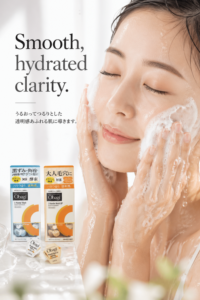
💪 Step 2 — Treat: Clear Advanced Lotion for Radiance & Even Tone
In Japanese skincare, what’s called a “lotion” (化粧水, keshousuig) isn’t what most Western routines would call a lotion. It’s a liquid applied right after cleansing — closer to a toner or essence in function, with a lighter texture than a serum. This step is about treating the skin while it’s freshly clean and still receptive.
The Clear Advanced Lotion uses four forms of vitamin C simultaneously. Not because more is automatically better, but because each form has different characteristics — different stability levels, different absorption rates, different behavior at the skin barrier:
- Ascorbic acid — the pure, fast-acting form
- Ascorbyl glucoside — stable, converts to active vitamin C after absorption
- Hexyl 3-glyceryl ascorbate — a newer derivative with enhanced penetration
- Magnesium ascorbyl phosphate — stable, with good moisture-retention properties
The stated focus is dullness and uneven tone — the flat, slightly grey quality that comes from accumulated dead cells, mild oxidative stress, and skin that isn’t turning over as efficiently as it used to. Users consistently report that their skin looks noticeably brighter within a few weeks, and that texture feels more refined. What’s interesting is how mild the formula feels in use — no tingling, no adjustment period — which is partly the result of the derivative-forward approach rather than relying on high-concentration pure ascorbic acid.
Application: a coin-sized amount on a cotton pad or pressed into the palms, then gently worked into skin after cleansing. You can layer it in areas of concern.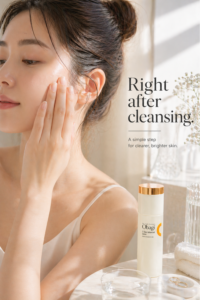
🌟 Step 3 — Lock In: Serum Gel for Pores, Texture & Hydration
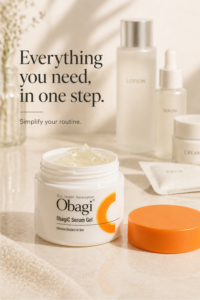
The Serum Gel is the hardest of the four to categorize, which is probably why it’s also the most interesting. It sits at the intersection of treatment and moisturizer — formulated with actives at a concentration closer to a serum, but with the texture and function of a lightweight gel cream.
For combination skin in a warm climate, this is the format that tends to work. Heavy creams feel suffocating by midday. Straight serums don’t provide enough moisture. The gel texture absorbs quickly, doesn’t leave a greasy layer, and gives the skin enough hydration to not feel tight by afternoon — which, if you’ve ever been in a situation where your skin feels parched but you can’t face applying anything heavy, is more useful than it sounds.
The formula combines two forms of vitamin C — pure ascorbic acid and 3-O-ethyl ascorbate, a fast-penetrating derivative — with a patented component called Nanofiber Gel® (palmitoyl dipeptide-18). This peptide-based ingredient improves how well the gel adheres to skin and supports the absorption of the actives. The range of concerns it addresses is deliberately broad: pore appearance, texture, firmness, dullness, and hydration.
You can use this as a standalone final step in a minimal routine, or layer it over the Clear Advanced Lotion in a fuller one. Both approaches are intentional.
⚠️ Not the best fit if…
- You have very dry skin and need real occlusive moisture — the gel texture won’t provide enough barrier support on its own
- You’re sensitive to fragrance (there’s a light, clean scent)
- You’re already on a potent L-ascorbic acid serum and don’t need to add more vitamin C layers

📊 The Obagi C Lineup: What Each Product Actually Does
To put it all in one place:
| Product | Step | Primary Concern | Best For | Price Range |
|---|---|---|---|---|
| Enzyme Powder Wash | Cleanse | Blackheads, congestion, surface texture | Most skin types, 20s–30s | Accessible |
| Enzyme Powder Wash DP | Cleanse | Enlarged pores, loss of firmness | 30s–40s, “adult pore” concerns | Accessible |
| Clear Advanced Lotion | Treat | Dullness, uneven tone | Most skin types | Mid-range |
| Serum Gel | Treat + Moisturize | Pores, texture, firmness, hydration | Combination skin, warm climates | Mid-range |
You don’t need all four. The two cleansers are either/or. The lotion and gel work independently or together. The simplest entry point is whichever step feels most broken in your current routine.
🧪 Ingredients: Why This Lineup Uses More Than One Form of Vitamin C
Vitamin C is one of those ingredients where everyone agrees it works, and almost no one agrees on how to use it. The research is solid — ascorbic acid has measurable antioxidant effects, inhibits melanin production, and supports collagen synthesis. The disagreement is about delivery.
Pure ascorbic acid is the most studied form. It’s also the most demanding. It needs an acidic pH environment to absorb effectively, oxidizes quickly once exposed to air and light, and can irritate skin that isn’t adjusted to it. There’s a reason so many vitamin C serums disappoint — the formula degrades before it gets a chance to work, or the concentration is high enough to cause problems before it produces results.
Vitamin C derivatives solve the stability problem. They’re chemically modified forms of ascorbic acid that don’t degrade as quickly and don’t require that low-pH environment. The tradeoff is that they need to convert back to active ascorbic acid after absorption — and how efficiently that happens depends partly on your individual skin chemistry.
What Obagi C does across this lineup is use both, at different steps, in different delivery systems. The powder wash brings enzymes and vitamin C to the cleansing step. The lotion stacks four derivative forms. The gel pairs pure ascorbic acid with a fast-converting derivative, held together by a moisturizing peptide that improves absorption.
The argument isn’t that more forms are always better. It’s that different forms work differently on different skin — and using several means you’re not dependent on any single one performing perfectly. If one derivative doesn’t convert efficiently on your skin, another is already active.
| Ingredient | Type | Role | Found In |
|---|---|---|---|
| Ascorbic acid | Pure vitamin C | Direct antioxidant; skin-conditioning | All 4 products |
| Ascorbyl glucoside | Stable derivative | Converts after absorption; gentler on skin | Clear Advanced Lotion |
| 3-O-ethyl ascorbate | Fast-acting derivative | High penetration; rapid conversion | Serum Gel |
| Magnesium ascorbyl phosphate | Stable derivative | Moisture retention; suits sensitive skin | Clear Advanced Lotion |
| Protease + Lipase | Enzymes | Break down dead protein + oxidized sebum in pores | Both Powder Washes |
| Yukino shita extract | Botanical astringent | Targets pore laxity, not just congestion | Powder Wash DP only |
| Palmitoyl dipeptide-18 (Nanofiber Gel®) | Peptide / moisturizer | Improves adherence and active absorption | Serum Gel only |
🗣 Real Voices from Real Users
Late 30s / Combination skin / Warm, humid climate
Used the Enzyme Powder Wash daily for two months. Reports that surface texture became noticeably smoother and T-zone congestion — which she’d had for years — significantly reduced. Had expected it to be too harsh for daily use. It wasn’t. Says she now feels unsettled if she runs out.
Early 40s / Normal to combination skin
Switched from the standard Powder Wash to the DP version after noticing her pores looked larger even on days when her skin wasn’t congested. Reports meaningful improvement in overall pore definition after consistent use — particularly around the nose and cheeks. Describes it as addressing something the regular version wasn’t quite reaching.
Mid-30s / Oily skin / Used Serum Gel as a standalone step
Found the Serum Gel sufficient as a single post-cleansing moisturizer through warmer months. Describes the texture as exactly right — not so light it feels like nothing, not heavy enough to feel like a commitment. Reports clearer, more even skin tone over six weeks. Notes it layered well on days she added the Clear Advanced Lotion underneath.
Review patterns compiled from verified Japanese beauty community sources. Individual results vary.
❓ Common Questions About Obagi C Skincare
Q: Do I need all four products, or can I start with just one?
One is fine. The Enzyme Powder Wash is the lowest-commitment entry point — it replaces your existing cleanser and works as a standalone upgrade. The Serum Gel works well on its own if you want treatment and moisture in a single step. The full lineup is for people who want a comprehensive system, not a prerequisite for results.
Q: What’s actually different between the Powder Wash and the Powder Wash DP?
Both use the same core formula — vitamin C and two enzymes. The DP adds yukino shita (saxifrage) extract, which targets pore laxity rather than just congestion. If your pores look enlarged even when your skin isn’t blocked or oily, the DP is addressing that more directly. If your main concern is blackheads and congestion, the standard version is the one.
Q: Can I use the Clear Advanced Lotion and the Serum Gel together?
Yes — that’s the full routine as intended. Apply the lotion first on clean skin, let it absorb, then follow with the gel. The lotion handles the treatment layer; the gel adds moisture and additional actives on top.
Q: Is this suitable for sensitive skin?
With some care. The Powder Wash uses enzymes rather than physical exfoliants, which is gentler — but daily use may be too frequent for reactive skin. The lotion and gel use derivative forms of vitamin C rather than high-concentration pure ascorbic acid, which reduces irritation risk. Starting every other day and watching how your skin responds is a reasonable approach.
Q: I already use a vitamin C serum from another brand. Can I use this too?
It depends on what you’re using. If you’re on a high-concentration L-ascorbic acid serum (15% or above), adding more vitamin C across multiple steps may be unnecessary. If you’re on a gentler or derivative-based formula, the Obagi C system can work alongside it or replace it. The key is not over-layering actives — more vitamin C isn’t always more effective.
✨ Where to Buy Obagi C Skincare Products
All four products ship internationally. Here’s how to find them depending on where you are.
Obagi C Enzyme Powder Wash
Shop on YesStyle
Shopee SG – LOLO JAPAN
Shopee MY – LOLO JAPAN
Obagi C Enzyme Powder Wash DP
Shopee SG – LOLO JAPAN
Shopee MY – LOLO JAPAN
Rakuten ROOM
Rakuten ROOM lists Japanese domestic prices. International shipping is available via Rakuten Global Express — a forwarding service shipping from Japan to 120+ countries including the US, Singapore, Malaysia, and Australia. Visit Rakuten Global Express (English Page)
Obagi C Clear Advanced Lotion
Shop on YesStyle
Shopee SG – LOLO JAPAN
Shopee MY – LOLO JAPAN
Rakuten ROOM
Obagi C Serum Gel
Shop on YesStyle
Shopee SG – LOLO JAPAN
Shopee MY – LOLO JAPAN
Rakuten ROOM
Reference prices (Japanese domestic retail): Enzyme Powder Wash approx. ¥1,980 / Enzyme Powder Wash DP approx. ¥2,420 / Clear Advanced Lotion approx. ¥4,950 / Serum Gel approx. ¥4,400. International platform prices will vary.
Disclosure: This article contains affiliate links. If you purchase through them, GlowCache may earn a small commission at no additional cost to you. Product information was compiled from official Obagi brand sources, Japanese beauty community reviews, and ingredient research. Alternative products and independent purchase paths are always available. This is not a paid promotion.
コメント