Contents
💭 Empathy & Realization
There’s a moment of quiet panic that settles in when someone casually asks “Did you get sunburned?” — and you realize they’re referring to what you thought were subtle shadows on your face. The question forces you to confront a truth you’ve been avoiding: what you’d been dismissing as temporary dullness has become visible enough for others to notice.
As Asian women, we have a complicated relationship with skin tone and pigmentation that goes far beyond simple beauty preferences. In many of our cultures, clear, even skin is tied to perceptions of health, youth, and confidence — making the gradual appearance of dark spots feel less like a cosmetic issue and more like a quiet alarm.
What makes pigmentation so insidious is how it accumulates. It doesn’t announce itself like a sudden breakout. It builds slowly — that day you forgot sunscreen, the stress-induced hormonal fluctuation, the harsh product that left a mark. One morning you look in the mirror and wonder when your complexion became so uneven.
Living in Asia’s intense UV environment accelerates this in ways that Western beauty advice rarely acknowledges. Year-round strong sun, high humidity that makes sunscreen feel uncomfortable to reapply, urban pollution causing oxidative stress — even a careful skincare routine may not be enough to prevent the gradual accumulation of pigmentation over the years.
Interestingly, the emotional toll of visible pigmentation often extends beyond appearance. The constant mental calculation of lighting, angles, and coverage becomes exhausting. And the cultural expectation in many Asian societies to maintain youthful, even-toned skin well into your thirties and forties adds yet another layer of pressure to an already frustrating situation.
That’s exactly the kind of background I kept finding in testimonials from Japanese women about DHC’s Medicated Melano Resist Cream — women describing the same slow-burn frustration, followed by something that sounded, cautiously, like real progress. DHC’s reputation for formulating for Asian skin’s specific sensitivities gave those testimonials extra weight.
💡 Texture & Feel
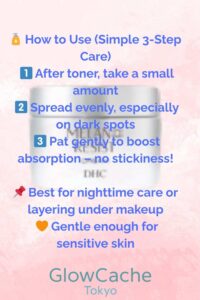
From the first application, DHC Medicated Melano Resist Cream distinguishes itself through a texture that balances richness with wearability — no small feat for a treatment cream meant to be used consistently over months.
The initial impression is substantial. The cream has a rich, almost balm-like consistency that immediately signals serious treatment rather than superficial cosmetic enhancement. This thickness is reassuring for anyone seeking real pigmentation improvement — it suggests concentrated actives and therapeutic intent rather than just moisturizing benefits.
Despite its rich appearance, the behavior upon application is more nuanced. As you warm it between your fingertips, it transforms into a silky, spreadable texture that glides across skin without pulling or resistance. Application feels both gentle and efficient, which matters for areas that may be sensitive from prior pigmentation or irritation.
What’s less obvious at first is how completely it absorbs. Rather than sitting heavily on the surface like many rich treatments, it penetrates gradually and fully, leaving skin nourished but never greasy or sticky. By morning, skin feels continuously comfortable and hydrated — not the tight, dry sensation that active treatments sometimes create.
The fragrance profile is worth noting for sensitive skin users: virtually neutral, with just the faintest clean, medicinal scent that disappears within minutes. This fragrance-free approach eliminates a common irritation trigger while reinforcing the product’s serious positioning.
It also layers well within existing routines — no pilling, no separation, no interference with other treatments. For those already working with multiple products to address various concerns, this kind of compatibility matters more than it might seem.
💪 Visible Effects
Reading through testimonials from users of DHC Medicated Melano Resist Cream, one thing stands out: the timeline of improvement is remarkably consistent across different skin types, ages, and pigmentation causes. Here’s what the patterns look like.
Weeks 1–2: Texture and makeup application change first
What shifts earliest isn’t the pigmentation itself — it’s skin texture. Areas with color irregularity tend to become smoother to the touch, and foundation starts applying more evenly over previously patchy zones. It’s the kind of quiet improvement that makes you think, “something’s different,” before you can pinpoint exactly what.
Around week 3: Edges start to soften
Reports of visible change tend to cluster around the three-week mark — not disappearance, but a gradual blurring of spot boundaries. Users describe it less as “fading” and more as spots beginning to merge back into the surrounding skin tone. The hard demarcation lines that once felt so obvious start to lose their edge.
Month 1+: Others notice before you do
Past the one-month mark, a recurring pattern in reviews: friends or colleagues commenting that skin looks “brighter” or “more even,” without being able to identify exactly what changed. This is arguably the most meaningful kind of result — the improvement reads as natural, not cosmetic.
Around week 6: Spots themselves begin to lighten
Multiple reviews cite six weeks as a turning point. Smaller spots fade significantly; longer-standing pigmentation becomes noticeably less prominent. The cumulative effect of consistent nightly use becomes harder to ignore.
An underreported benefit: prevention
What’s less commonly highlighted — but worth noting — is how many users mention that new spots stopped forming during use. The combination of tranexamic acid and arbutin complex appears to be suppressing melanin production at the source, not just treating what’s already there. For anyone dealing with ongoing triggers (sun exposure, hormonal fluctuations, stress), this preventive dimension may matter as much as the corrective results.
🧪 Ingredients
The formulation logic here is worth paying attention to. DHC didn’t just stack brightening actives — they built around them.
Tranexamic acid is the anchor. Unlike surface-level brighteners, it works by interrupting the inflammatory signals that trigger melanin production in the first place. This makes it particularly relevant for pigmentation driven by hormonal shifts, stress, or environmental factors — the exact causes most common in Asian urban contexts.
The Direct IB Extract (arbutin complex) takes a complementary approach: directly inhibiting tyrosinase, the enzyme responsible for melanin synthesis. One ingredient dials down the signal; the other blocks the mechanism. Together, they address pigmentation from two directions simultaneously.
What’s less commonly discussed is why marine collagen and aloe vera are in a brightening cream. Here’s the logic: pigmentation treatment only works if your skin is healthy enough to repair itself. Collagen provides the structural support that aging and environmental stress erode; aloe manages the inflammation that can actually worsen hyperpigmentation if left unchecked. These aren’t filler ingredients — they’re the reason this formula works for sensitive skin types that harsher treatments typically aggravate.
Coix seed extract is a nice touch for anyone familiar with traditional Asian skincare. Used in Japanese and Chinese medicine for generations for skin clarity and texture, its inclusion feels intentional rather than decorative. And dipotassium glycyrrhizate rounds out the formula by ensuring that with all these actives working together, the overall effect remains gentle enough to use nightly without causing the rebound irritation that so often undermines brightening treatments.
🗣️ Real Voices from Real Users
Age 48 / Combination Skin / Hormonal Pigmentation — Yokohama
After dealing with melasma for years following pregnancies, I’d tried countless treatments with minimal success. This cream has been different — gentle enough for my sensitive skin but effective enough to make real progress. After three months, the dark patches on my cheeks have faded significantly. My dermatologist was impressed and asked what I’d been using.
Age 52 / Mature Skin / Sun Damage — Osaka
I bought this to address decades of accumulated sun damage. The cream is rich and luxurious — perfect for my aging skin. My age spots have lightened considerably, and my overall complexion looks more youthful. I look in the mirror now and feel genuinely surprised by the improvement.
Age 34 / Sensitive Skin / Post-Inflammatory Pigmentation — Tokyo
I developed dark spots after a series of stress-related breakouts, and they seemed permanent despite trying various brightening products. This cream has been incredibly gentle while actually delivering results. After six weeks, the discoloration has faded dramatically and my skin texture is smoother overall.
Age 41 / Normal Skin / Environmental Pigmentation — Nagoya
Living in an industrial city, my skin accumulated damage I didn’t realize was happening until it became obvious. This cream has reversed so much of that — my skin looks clearer and more radiant than it has in years. I wake up with soft, hydrated skin every morning.
Age 39 / Dry Skin / Mixed Pigmentation — Kyoto
I had various types of pigmentation — some from sun exposure, some hormonal — and most treatments were either too harsh or too weak. This cream exceeded my expectations. Rich enough to nourish my dry skin, effective enough to actually fade spots. After two months, people keep asking if I’ve had treatments done.
✨ Where to Buy
🇸🇬 Singapore
Available through LOLO JAPAN on Shopee SG — an authorized Japanese beauty retailer based in Singapore.
🌍 International / US
Browse the item on Rakuten ROOM, then use Rakuten Global Express to ship authentic Japanese products directly to your country.
🌸 Browse on Rakuten ROOM
📦 Ship via Rakuten Global Express
🇯🇵 Reference Price
Japanese domestic retail price: approximately ¥4,400 (tax included / 50g). When purchasing DHC products, verify seller authorization and check for proper packaging including batch codes.
📎 Reference
- DHC Medicated Melano Resist Cream — Official Website
- Image © DHC Corporation

コメント