Contents
- 💭 Empathy & Realization
- ⚡ Quick Verdict: Who This Is For
- 🧪 Ingredients: Why the Formula Works
- 📝 How to Use: Building It Into a Routine That Sticks
- 💡 Texture & Feel: What It Actually Feels Like
- 💪 Visible Effects: Hydration, Texture & Glow Over Time
- 🗣 Real Voices from Real Users
- ❓ Common Questions About Matsukiyo W/M AAA Moist Intensive Lotion
- ✨ Where to Buy Matsukiyo W/M AAA Moist Intensive Lotion
- 📎 Reference
- 💭 Empathy & Realization
- ⚡ Quick Verdict: Who This Is For
- 🧪 Ingredients: Why the Formula Works
- 📝 How to Use: Building It Into a Routine That Sticks
- 💡 Texture & Feel: What It Actually Feels Like
- 💪 Visible Effects: Hydration, Texture & Glow Over Time
- 🗣 Real Voices from Real Users
- ❓ Common Questions About Matsukiyo W/M AAA Moist Intensive Lotion
- ✨ Where to Buy Matsukiyo W/M AAA Moist Intensive Lotion
- 📎 Reference
💭 Empathy & Realization
It was close to midnight in Tokyo when I fell down a Reddit thread I hadn’t meant to read for twenty minutes. Someone had posted a fairly simple question: “is anyone else buying skincare based on what’s trending instead of what’s actually in it?” The replies just kept coming. A lot of them mentioned K-beauty by name, not as a complaint exactly, but with a kind of tired honesty. Shelves full of serums bought because a video made them look essential. Half of them barely touched by the third week.
What caught my attention wasn’t the K-beauty fatigue itself. It was how many people, buried a few comments down, mentioned going back to basics. A surprising number of those basics were Japanese drugstore brands. Not luxury imports, not anything with a waitlist. Just the kind of skincare Japanese shoppers grab on a regular pharmacy run, priced like it and packaged like it, with none of the ceremony.
That’s the gap I keep noticing between how skincare gets discovered abroad and how it actually functions here. A trending serum gets the spotlight. A reformulated drugstore lotion sitting quietly on a matsukiyo shelf does not, even when the two are working with similar active ingredients. matsukiyo is one of Japan’s largest pharmacy chains, and W/M AAA is its own in-house skincare line, not an imported prestige brand. It’s the kind of thing you’d toss in a basket next to sunscreen and cold medicine.
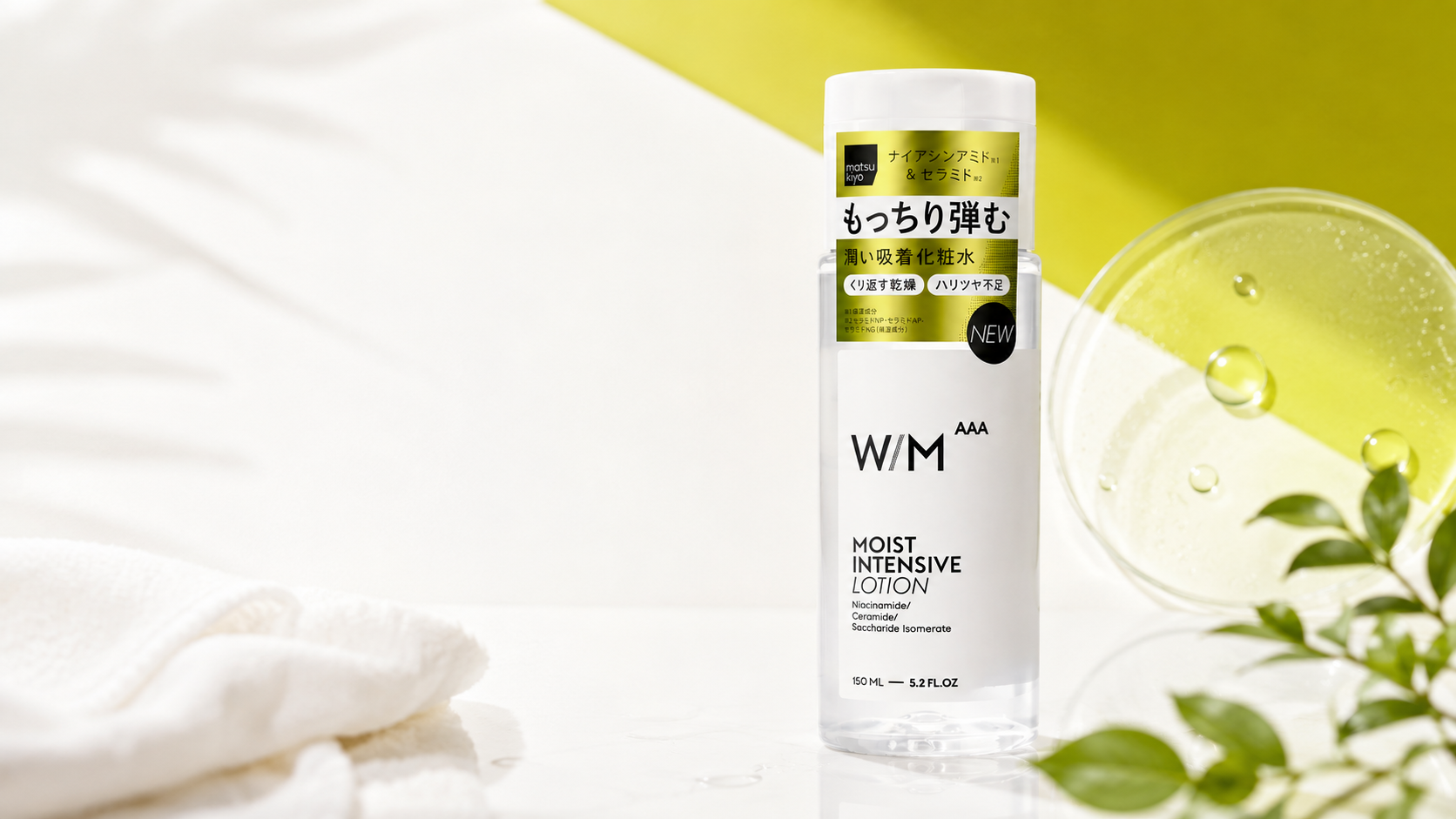
The lotion at the center of that Reddit thread’s more skeptical replies was the W/M AAA Moist Intensive Lotion, a recent reformulation built around niacinamide and ceramides, the two ingredients half of that comment section was already asking for by name. So that became the actual question: does a pharmacy-shelf reformulation hold up against routines people have been building around far more expensive alternatives? Or is “drugstore” doing a lot of the skepticism’s work on its own?
⚡ Quick Verdict: Who This Is For
✅ Good fit if you…
- Want niacinamide and ceramides in one step without paying prestige-brand markup
- Deal with tight, dehydrated skin from forced-air heat, air conditioning, or dry winters
- Are tired of rotating expensive serums and want to simplify to fewer, more functional products
- Have combination or normal-to-dry skin that tolerates actives reasonably well
❌ Skip it if you…
- Are fragrance-sensitive: this formula is scented
- Have very reactive or compromised skin that flags to new actives easily
- Want a lightweight, watery toner rather than a gel-essence texture
🧪 Ingredients: Why the Formula Works
| Key Ingredient | Function |
|---|---|
| Niacinamide (3%) | Supports barrier function and even tone at a concentration low enough for daily use without irritation |
| Ceramide NP, AP, NG | Three lipid types that help maintain the skin barrier and reduce moisture loss over time |
| Hyaluronic Acid (Na) | Draws in and holds moisture at the surface, contributing to the plumped feel on application |
| Saccharide Isomerate | A sugar-derived humectant (marketed by matsukiyo as “Aqua Magnet”) that binds to skin for sustained hydration |
| Panthenol | Pro-vitamin B5 that supports the skin’s own repair process and calms mild irritation |
| Phytosphingosine | A lipid that supports a balanced skin microbiome alongside the ceramide complex |
What’s notable here isn’t any single ingredient. Niacinamide and ceramides individually are common enough. It’s that matsukiyo settled on 3% niacinamide, a level generally considered effective for barrier support and tone without crossing into the irritation territory higher percentages can bring. That’s a formulation choice, not a marketing one. It suggests this was built for repeat, everyday application rather than a one-off “high potency” claim on a box.
The three-ceramide approach (NP, AP, NG) is doing more work than it might look like on a label. Each type occupies a slightly different role in the skin’s lipid structure, and layering them is closer to how dermatological ceramide research approaches barrier repair than what most budget formulas bother with. Saccharide isomerate, which matsukiyo markets as “Aqua Magnet,” binds to skin proteins rather than sitting passively on the surface. That’s part of why the hydration here tends to read as longer-lasting than a simple humectant blend.
Full ingredient list confirmed against the product’s official listing and matsukiyo’s own site: Water, Glycerin, BG, Niacinamide, DPG, Pentylene Glycol, Polyglyceryl-10, Saccharide Isomerate, Ceramide NP, Ceramide AP, Ceramide NG, Hydrolyzed Sodium Polyacrylate Starch/Water-Soluble Proteoglycan, Sodium Hyaluronate, Phytosphingosine, Polyquaternium-51, Polyquaternium-61, Panthenol, PEG-60 Hydrogenated Castor Oil, Polyglyceryl-10 Pentastearate, Bis-PEG-15 Methyl Ether Dimethicone, Sodium PCA, Phenoxyethanol, Citric Acid, Sodium Citrate, Potassium Hydroxide, Carbomer, Polysorbate 80, Behenyl Alcohol, Sodium Stearoyl Lactylate, Fragrance.
📝 How to Use: Building It Into a Routine That Sticks
This slots in right after cleansing, before anything heavier like a serum or moisturizer. It functions as a lotion-toner hybrid, so it’s the step that preps skin to actually absorb what comes next, not a step you’d layer on top of other products. If your current routine already has a separate hydrating toner, this is built to replace it rather than stack alongside it.
The official application guidance calls for a coin-sized amount, pressed rather than swiped into skin. For anyone coming from a multi-step K-beauty routine, that’s the appeal here: this one bottle is doing the job that a toner-essence combination often handles in two separate steps.
On cost per use: 150ml at two pumps morning and night works out to roughly two to three months of daily use per bottle. At the ¥1,320 Japanese retail price, that’s somewhere around ¥15 to ¥20 (roughly 10 to 13 cents USD) per application, both AM and PM combined into one product. Compare that to running a separate niacinamide serum and a ceramide moisturizer, and the single-bottle math starts to make a real case for itself.
💡 Texture & Feel: What It Actually Feels Like
The texture is the first thing reviewers tend to flag, usually because it doesn’t match either category it sits between. It’s thicker than a typical watery toner but lighter than an essence, closer to a gel that turns fluid the moment it touches skin. Poured into a palm, it holds enough body to feel like a treatment step rather than a splash of water.
Application spreads easily, without the dragging sensation some viscous formulas have. Across reviews, the most consistent comment is about how it “presses in” rather than sits on top, a texture detail matsukiyo’s own instructions actually lean into by recommending you press rather than pat it into skin.
Absorption lands in that 30 to 60 second range that matters for anyone stacking products afterward. Fast enough not to hold up a routine, slow enough that it doesn’t feel like it’s just evaporating. A minority of reviews mention a slightly tacky in-between phase for oilier skin types, worth knowing if that’s something you’re sensitive to.
The finish reads as plumped rather than coated. Skin looks hydrated without an obvious sheen, which makes it easy to move into makeup or sunscreen without pilling. In humid conditions it doesn’t add noticeable weight. In dry, heated indoor air, it holds up better than a lighter formula would.
💪 Visible Effects: Hydration, Texture & Glow Over Time
The most consistent theme across feedback is immediate comfort. The plumped, less-tight feeling shows up from the first few uses, which matters for anyone who’s been burned by products that promise results but feel like nothing in the moment.
Within the first couple of weeks, a common pattern in reviews is smoother texture, particularly around areas prone to mild flaking from dehydration rather than an underlying skin condition. Users who mention combination or normal skin describe the biggest shift in how makeup sits afterward, with less catching on rough patches.
Brightening shows up more gradually. Reviewers who’ve used it consistently for two to three weeks tend to describe a subtle evenness rather than dramatic lightening. That lines up with what a 3% niacinamide concentration is generally expected to deliver: support, not a dramatic before-and-after.
A recurring thread in longer-term reviews, four weeks and beyond, is skin holding onto moisture through the day without the usual midday tightness. That kind of result matters more in a place with forced-air heat or aggressive air conditioning than it would somewhere consistently humid. Some reviewers also note improved tolerance for other actives afterward, a plausible sign that barrier function has strengthened over that stretch.
⚠️ Not the best fit if…
- You’re avoiding fragrance in your routine: this formula is scented
- Your skin reacts quickly to new actives, even mild ones like 3% niacinamide
- You specifically want a thin, water-like toner rather than a gel-essence texture
Which loops back to that Reddit thread. Is a drugstore reformulation a real substitute for a more expensive K-beauty routine, or just a cheaper placeholder? Based on what actually shows up in the ingredient list and the pattern of reviews, it reads less like a substitute and more like a formula built by people who had to make niacinamide and ceramides work at a price point where marketing budgets weren’t an option. That’s a different story than “cheap alternative,” and probably the more useful one if you’re the kind of reader who ends up in that thread at all.
🗣 Real Voices from Real Users
“I was skeptical about drugstore skincare after using expensive K-beauty products, but this lotion changed my mind. The niacinamide concentration is strong enough to help with post-acne marks but gentle enough for daily use.” — Age 28, Combination Skin, Tokyo
“It absorbs fast, which matters on busy mornings, and it’s kept my dry skin comfortable through the day. The ceramides seem to have helped my barrier. I can layer other products now without the stinging I used to get.” — Age 35, Dry Skin, Yokohama
“It’s fine on my sensitive skin, though I noticed the fragrance more than I expected from a ‘gentle’ formula, and I wish the tackier phase during absorption were shorter. Still keeping it in rotation, just not my only step.” — Age 31, Sensitive Skin, Osaka
These impressions are drawn from Japanese beauty review platforms, where reviewers tend to write in more clinical detail about texture and tolerance than star ratings alone would suggest. Reliable hydration and a real barrier boost come up again and again for anyone rebuilding a simpler routine. Fragrance sensitivity is the one recurring caveat.
❓ Common Questions About Matsukiyo W/M AAA Moist Intensive Lotion
Is this the same as a Korean essence or ampoule?
Not quite. It sits closer to a toner-essence hybrid, thinner than most K-beauty essences and thicker than a typical toner. It’s built to replace that step rather than layer alongside it.
I’m already using a niacinamide serum. Is this redundant?
At 3%, it’s a moderate concentration most routines can accommodate. If you’re already running a higher-percentage niacinamide serum elsewhere, it’s worth deciding whether you need both, or whether this becomes your one niacinamide step.
Does it actually help with dry winter skin?
This is where the ceramide-heavy formulation earns its keep. Reviewers in colder, drier climates report it holding up better against forced-air heat than lighter, water-based toners do.
How strong is the fragrance?
Noticeable. Multiple reviewers mention it even when they otherwise liked the formula, so if you’re building a fragrance-free routine, this isn’t it.
Is it actually cheaper than comparable K-beauty or Western drugstore products?
At Japanese domestic pricing, yes, and by a meaningful margin once you factor in that it’s replacing what’s often a two-product step (toner plus essence) rather than adding a third thing to your shelf.
✨ Where to Buy Matsukiyo W/M AAA Moist Intensive Lotion
Singapore & Malaysia readers: buy direct through LOLO JAPAN, our authorized Shopee store.
US & international readers: order through YesStyle, or via Rakuten if you already shop there.

Reference Price: Japanese domestic retail price is approximately ¥1,320 (tax included) for 150ml.
📎 Reference
- matsukiyo W/M AAA Official Website
- Full ingredient list confirmed via official product listing (Cocokara Fine / @cosme, cross-referenced August 2026)
- Image © matsukiyo / Matsukiyo Cocokara & Co.
コメント