- 💭 Empathy & Realization
- ⚡ Quick Verdict: Who This Is For
- 💡 Texture & Feel: Lightweight Absorption Without the Grease
- 💪 Visible Effects: Frizz Control, Shine & Dry End Recovery
- 🧪 Ingredients: Why a Single-Ingredient Formula Actually Makes Sense
- 🗣️ Real Voices from Real Users
- ❓ Common Questions About Oshima Tsubaki Camellia Oil
- ✨ Where to Buy Oshima Tsubaki Camellia Oil
- 📎 Reference
💭 Empathy & Realization
Beauty shelves don’t lie about what actually works. Trends arrive loudly — new textures, new routines, new ingredients that promise everything — and disappear just as fast. But at the pharmacy I pass through most weeks in Tokyo, there’s one product that has never moved. Not to a better shelf, not to a discount bin. Just quietly there, in the same spot, for longer than I can remember.
Oshima Tsubaki Camellia Oil doesn’t advertise its staying power. It doesn’t need to.
What finally made me look closer wasn’t a campaign or a recommendation algorithm. It was simple curiosity: what does a product have to actually do to stay on a Japanese pharmacy shelf for decades? Japan’s beauty market is not sentimental. Products that don’t perform get replaced. The fact that this one hasn’t moved is, in itself, a kind of review.
Camellia oil — tsubaki in Japanese — has been part of hair care in Japan for over a thousand years. Not as a heritage marketing claim, but as a practical answer to a real problem: how do you keep hair healthy in a country where humidity shifts dramatically between seasons, where heat styling is common, and where the expectation of smooth, manageable hair is simply part of daily life? The answer, apparently, has been sitting in a small amber bottle this whole time.
What’s less known outside Japan is that Oshima Tsubaki sources its camellia oil exclusively from Oshima Island, a small island off the coast of Tokyo with a centuries-old tradition of camellia cultivation. The cold-pressing method used there preserves the oil’s fatty acid structure in a way that industrial extraction doesn’t. That’s not a story the label tells you. But it explains why users who switch from generic camellia oils often notice a difference.
I started paying attention to which customers at LOLO JAPAN kept reordering this particular product. My friend Maco, who runs the shop, mentioned that it has one of the highest repurchase rates in her inventory — not because it’s trendy, but because people simply don’t stop using it once they start. That pattern, more than any single review, is what made me want to write about it properly.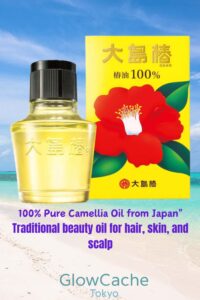
⚡ Quick Verdict: Who This Is For
Oshima Tsubaki Camellia Oil is a good fit if:
- Your hair feels dry or brittle, especially at the ends
- You want a hair oil that absorbs quickly without leaving a greasy finish
- You prefer fragrance-free, single-ingredient products
- You deal with frizz in humid weather and want something lightweight
- You’re looking for one product that works on both hair and dry skin patches
Skip this if:
- You want strong hold or a styling effect — this is a treatment oil, not a styler
- You have very fine hair that weighs down easily (even light oils can be too much)
- You’re expecting dramatic visible results within the first few days
💡 Texture & Feel: Lightweight Absorption Without the Grease
The most common surprise users report is how unlike a typical hair oil this feels. Most people expect something heavier — the kind of product that requires careful rationing to avoid looking like you’ve just come out of a deep-fry situation. Camellia oil doesn’t work that way.
The consistency is almost fluid, closer to water than to the dense serums marketed as “lightweight.” It spreads immediately between the palms with minimal warmth, and transfers to hair without any dragging or clumping. Three to four drops is enough for medium-length hair. Four to five for longer or thicker hair. The margin for error is wider than most oils — a drop too many absorbs rather than sits.
Absorption speed varies depending on hair condition. On drier, more damaged hair, it disappears quickly. On hair in better condition, it leaves a subtle surface finish that reads as natural shine rather than product buildup. Either way, there is no residue by the time hair is dry.
There is no scent. This is either a non-issue or a genuine selling point depending on your routine — it layers cleanly under perfume or scented styling products without any interaction. For those who react to fragrance, it’s one less variable to manage.
On skin, the texture behaves similarly: fast absorption, no film, no tackiness. It works particularly well on rough patches — elbows, knees, cuticles — where thicker creams often sit on top rather than penetrate.
💪 Visible Effects: Frizz Control, Shine & Dry End Recovery
The effects users most consistently describe fall into three categories: frizz reduction in humid conditions, improvement in dry or split ends, and a shift in overall hair texture that becomes noticeable around the two-week mark with regular use.
Frizz control is the most immediate effect. Users in humid climates — Singapore, the Philippines, coastal US cities — report that applying two to three drops to damp hair before air-drying significantly reduces the flyaways and expansion that humidity causes. This isn’t the same as anti-frizz products that coat the hair shaft with silicone. The effect is more like the hair finding its natural texture rather than being forced into one.
For damaged ends, the feedback pattern suggests gradual improvement rather than an overnight fix. Most users notice a difference in how their ends feel — less rough, less prone to tangling — within the first week. The visual improvement in split ends takes longer, and it’s worth being clear: oil doesn’t repair structural damage. What it does is reduce the friction and moisture loss that makes damage look worse and progress faster.
The shine that develops with consistent use reads differently from product-induced gloss. Light moves through the hair rather than bouncing off a coating. In practical terms, this means hair looks healthy in varied lighting rather than only in flattering conditions.
⚠️ Not the best fit if…
- You have very fine or low-porosity hair — even a small amount can flatten the hair
- You’re expecting heat protection — camellia oil has some thermal properties but is not a substitute for a dedicated heat protectant
- You want a product that doubles as a styling agent with hold
🧪 Ingredients: Why a Single-Ingredient Formula Actually Makes Sense
There is one ingredient in Oshima Tsubaki Camellia Oil: Camellia Japonica Seed Oil. That’s it. No preservatives, no fragrance, no emulsifiers. For a beauty product, this level of minimalism is genuinely unusual — and worth understanding rather than just accepting as a marketing angle.
The oleic acid content is the key detail here. Oleic acid has a molecular structure that allows it to pass through the hair cuticle rather than simply sitting on top of it — which is why camellia oil absorbs differently from heavier oils like coconut or castor. For hair that’s dry or damaged, this means moisture is delivered to where it’s actually needed, not just applied to the surface.
The similarity to the scalp’s natural sebum also matters for compatibility. Oils that closely resemble sebum tend to integrate with existing oils rather than compete with them or create buildup. This is part of why camellia oil works consistently across different hair types — it’s not fighting the hair’s own chemistry.
Interestingly, the antioxidant content — vitamin E and polyphenols — provides a secondary benefit that often goes unmentioned: protection against oxidative stress from UV exposure and pollution. For anyone in a high-UV or urban environment, this is relevant beyond just hair care.
The single-ingredient formulation also means the product’s performance is entirely dependent on the quality of the oil itself. Oshima Tsubaki sources from Oshima Island using cold-press extraction, which preserves the fatty acid profile more completely than heat-based methods. This is the variable that distinguishes this product from generic camellia oils available elsewhere.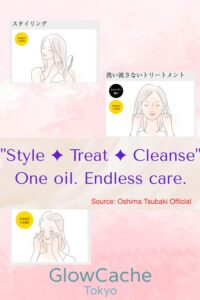
🗣️ Real Voices from Real Users
Age 31 / Curly hair, dry / Singapore
Reported that frizz in Singapore’s humidity decreased noticeably after two weeks of consistent use on damp hair. Also uses it on elbows and knees. Notes the single-ingredient formula as a significant factor given sensitivity concerns.
Age 43 / Straight hair, sensitive skin / Philippines
Had avoided hair oils due to scalp sensitivity. Found no irritation with this product. Uses a small amount nightly on hair ends and cuticles. Describes it as the first hair oil that didn’t require careful rationing.
Age 26 / Color-treated, bleached / Malaysia
Used primarily for damaged ends after bleaching. Noted improvement in how ends felt within the first week — less rough to the touch, less tangling. Does not describe it as repairing damage, but as preventing further deterioration.
Compiled from Japanese review platforms and retailer feedback.
❓ Common Questions About Oshima Tsubaki Camellia Oil
Can I use this on my scalp, or just the ends?
Most users apply it to mid-lengths and ends rather than the scalp directly. Applying oil to the scalp can work for some hair types, but for anyone with oily roots or fine hair, it’s generally better to keep it away from the scalp entirely. The ends are where moisture loss and damage concentrate, so that’s where the benefit is most noticeable.
Is this safe for color-treated or chemically processed hair?
The single-ingredient formula means there are no chemicals that might interact with color treatments. Users with bleached or permed hair generally report no issues. As always, if your scalp is currently irritated or recently treated, allow it to settle before introducing new products.
How often should I use it?
Daily use on damp hair before drying is the most common pattern in feedback. Some users apply a small amount to dry hair for frizz control or shine. Because the oil absorbs cleanly, daily use doesn’t typically lead to buildup — though fine hair types may want to limit to every other day.
Does it work as a heat protectant?
Camellia oil has some thermal resistance properties, but it is not a substitute for a dedicated heat protectant. If you regularly use high-heat tools, use a proper heat protectant first and apply camellia oil afterwards as a finishing treatment.
Can I use it on my skin as well as my hair?
Yes — this is one of the more practical aspects of the product. Users commonly apply it to dry patches on elbows and knees, and to cuticles. The same absorption properties that make it effective on hair work on skin. It is not a facial moisturizer in the conventional sense, but some users with dry skin use it on the body without issue.
✨ Where to Buy Oshima Tsubaki Camellia Oil
🇸🇬 Singapore
Available through LOLO JAPAN on Shopee SG — an authorized Japanese beauty retailer based in Singapore.
🇲🇾 Malaysia
Ships directly to Malaysia with tracking. Authentic Japanese products with verified seller ratings.
🌍 International / US
Shop on YesStyle with worldwide shipping — or browse on Rakuten ROOM and ship anywhere via Rakuten Global Express, a Japanese forwarding service that delivers authentic Japanese products to over 100 countries.
🛒 Shop on YesStyle
🌸 Browse on Rakuten ROOM
📦 Ship via Rakuten Global Express
🇯🇵 Reference Price
Japanese domestic retail price: approximately ¥1,500–¥2,000 depending on size. When purchasing Oshima Tsubaki products, verify seller authorization and check for proper packaging including batch codes.
📎 Reference
- Oshima Tsubaki Official Website
- @cosme user reviews (Japanese)
- Image © Oshima Tsubaki Co., Ltd.

コメント