- Contents
- 💭 Empathy & Realization
- ⚡ Quick Verdict: Who This Is For
- 🔧 Design & Technology: Why There Are Two
- 📝 How to Use: Getting the Curl Right
- 📊 Curved vs Edge-Free: Side-by-Side
- 💡 Feel & Grip
- 💪 Visible Effects: Curl Hold & Comfort
- 🗣️ Real Voices from Real Users
- ❓ Common Questions About These Eyelash Curlers
- ✨ Where to Buy
- 📎 Reference
Contents
- 💭 Empathy & Realization
- ⚡ Quick Verdict: Who This Is For
- 🔧 Design & Technology: Why There Are Two
- 📝 How to Use: Getting the Curl Right
- 📊 Curved vs Edge-Free: Side-by-Side
- 💡 Feel & Grip
- 💪 Visible Effects: Curl Hold & Comfort
- 🗣️ Real Voices from Real Users
- ❓ Common Questions
- ✨ Where to Buy
- 📎 Reference
💭 Empathy & Realization
“Shiseido 213” — that’s what showed up in the SNS comments I was scrolling through. I opened Shiseido’s own site to find it, and the number wasn’t anywhere. Not on the product page, not in the search results, nowhere.
It turned out to be simple. In August 2024, the price and packaging changed, and the model number quietly disappeared along with it. Same curler inside the box. Just no name left on the outside to search for.
This kind of small confusion turns up a lot with Japanese beauty tools. While I was looking into the renamed curler, another one caught my eye — this one branded “Maquillage.” Search in Japanese and the relationship is obvious. Read English reviews and forums, though, and quite a few people seem to think these are two competing companies.
Maquillage is a makeup-focused brand Shiseido launched itself in 2005 — different packaging, different shelf placement, so the mix-up is an easy one to make. Same company, same category, two separate products on purpose.
Why bother making two? The answer turned out to be about eyelid shape.
⚡ Quick Verdict: Who This Is For
Before the deep dive, here’s the short version.
This is a good fit if you:
- Have hooded or monolid eyes and standard curlers pinch your eyelid or miss the outer corner
- Have searched for “Shiseido 213” and gotten confused when it didn’t turn up
- Want to understand whether Shiseido and Maquillage curlers are actually different products before buying one
- Have straight, stubborn Asian lashes that don’t hold a curl with a typical Western curler
This is probably not for you if:
- You already have a curler that works well for your eye shape — there’s no need to switch
- You have round or deep-set eyes with plenty of lid space; most mainstream curlers already fit you fine
🔧 Design & Technology: Why There Are Two
Here’s the detail that actually explains the two-curler situation: Shiseido’s own online store published a beauty guide comparing these exact two curlers by eyelid type — monolid, hooded, and double eyelid — written by one of their in-house hair and makeup artists. This isn’t a case of one curler being objectively better. It’s a case of two different curve shapes solving two different eyelid problems.
The Shiseido Eyelash Curler (the one formerly labeled 213) has a rounder, more pronounced curve. It’s been sold for over two decades and was developed using research on Japanese women’s eyelid shapes specifically, according to the brand’s own product description. The stronger curve gives a firmer grip at the lash root, which is the detail that matters most for straight, resistant Asian lashes that tend to fall flat again within hours.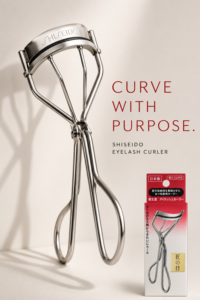
The Maquillage Edge Free Eyelash Curler takes a different approach. As the name suggests, the side posts are shaped so they don’t press against the eyelid itself — a specific fix for the pinching problem that hooded eyes run into with curlers designed around more open eye shapes. The curve is gentler and the frame is built to catch even the shorter lashes at the inner and outer corners, which is where a lot of curlers lose their grip entirely.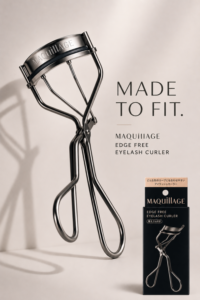
Worth knowing if you’re shopping: there’s also a smaller “mini” version sold under the Shiseido name (sometimes listed as #215), built specifically for touch-up curling in tight areas like the outer corner — not a substitute for a full-size curler, but a useful companion once you already have one. Replacement silicone pads (labeled #214) are sold separately for either curler and are worth keeping on hand, since a worn-out pad is the most common reason a good curler stops performing.
📝 How to Use: Getting the Curl Right
Both curlers use the same basic technique. Look down, position the curler at the base of your lashes — as close to the lash line as you can get without catching the eyelid itself — and clamp gently. Hold for a few seconds, then release, move slightly toward the tips, and repeat once or twice, easing off the pressure as you move outward.
The step people skip: work in from the outer corner separately if your curler doesn’t catch it on the first pass. This is exactly the gap the Edge Free design was built to close, so if you’re using the standard curved curler and missing the outer corner lashes, that’s a known limitation, not a technique problem on your end.
On maintenance: the silicone pad is the part that wears out first, typically losing its grip and developing a crease after several months of daily use. Replacement pads (#214) are inexpensive and take seconds to swap in — worth doing before the pad starts pulling at lashes instead of cleanly gripping them.
On cost per use: a single curler, used daily and maintained with pad replacements every few months, reasonably lasts for years rather than months — this is a buy-once category, not a repeat-purchase one, which changes the math compared to most makeup tools.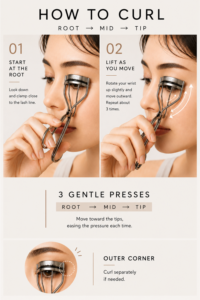
📊 Curved vs Edge-Free: Side-by-Side
| Feature | Shiseido Eyelash Curler (formerly #213) | Maquillage Edge Free Eyelash Curler |
|---|---|---|
| Curve | Rounder, more pronounced | Gentler, follows a flatter lid shape |
| Eyelid contact | Side posts may touch the eyelid on hooded eyes | Edge-free design keeps posts off the eyelid |
| Best for | Hooded eyes wanting a firm, strong curl at the root | Hooded eyes prone to pinching; short outer-corner lashes |
| Price | ¥1,320 (Japan retail) | ¥1,100–1,320 (Japan retail) |
💡 Feel & Grip
Both curlers are stainless steel with a similar handle span, so the in-hand weight and squeeze pressure feel close to identical. The difference shows up the moment the frame meets the eyelid rather than in how the tool feels to hold.
The standard curved curler’s stronger arc is the detail reviewers bring up most — it grips more decisively at the base, which straight Asian lashes tend to need, but that same firmness is what can catch the eyelid on a hooded lid if the angle is even slightly off. The Edge Free version trades some of that firm grip for a shape that’s more forgiving of exactly where the curler lands, which shows up as less pinching but occasionally a softer curl on very stubborn lashes.
The mini/touch-up curler, by comparison, has a noticeably smaller frame — reviewers describe it as fiddly to use on the whole eye but genuinely useful for the handful of short lashes at the corners that a full-size curler usually skips.
💪 Visible Effects: Curl Hold & Comfort
The first few uses
Across reviews, the standard curved curler tends to get immediate praise for lift — lashes visibly curl from the root rather than just bending in the middle, which is the difference between a curl that looks intentional and one that looks like it’s already relaxing. The trade-off shows up just as quickly for hooded-eye users: several reviewers mention needing to angle the curler carefully to avoid catching the eyelid crease.
Where the Edge Free curler earns its name
The most consistent feedback on the Maquillage version is relief — users switching from the standard curler specifically mention no longer feeling the side posts press into the lid. A few reviewers who tried it after years on the curved version note it took some adjustment, since the gentler curve initially felt less dramatic, but settled into their routine once they adjusted their grip pressure.
The honest caveat
Neither curler is universally preferred — this isn’t a case of one replacing the other. A meaningful share of reviewers who tried switching went back to their original curler, finding the other curve simply didn’t match their eyelid shape as well. Eye shape varies enough within the broad category of “hooded” or “monolid” that the only reliable way to know which curve suits you is to know which specific problem you’re solving: pinching, or insufficient grip.
So if the original question was whether a Japanese curler actually solves the hooded-eye problem that Western curlers tend to miss, the answer across the feedback is yes, consistently — but which of the two you want depends on whether pinching or grip strength is the more frustrating part of your current routine.
⚠️ Not the best fit if…
- You have round or deep-set eyes with no history of pinching or missed corners — a standard Western curler likely already works fine
- You’re expecting one curler to solve both firm grip and zero eyelid contact — that trade-off doesn’t fully disappear with either model
- You’re shopping specifically for the old “213” model number — it no longer exists under that name, though the product itself is unchanged
🗣️ Real Voices from Real Users
❓ Common Questions About These Eyelash Curlers
Whatever happened to the Shiseido 213?
Nothing happened to the product — only the name. In August 2024, Shiseido renewed the packaging and pricing, and the “213” model number was dropped in favor of simply “Shiseido Eyelash Curler.” According to Shiseido’s own customer service, the curler itself is unchanged.
Is Maquillage a different company than Shiseido?
No. Maquillage is a makeup-focused brand Shiseido launched itself in 2005. It has separate packaging and shelf placement in Japan, which is likely why the two get mistaken for competing brands outside Japan.
Which one should I get if I have hooded eyes?
Both are designed with hooded and monolid eyes in mind, according to Shiseido’s own comparison guide, but they solve different problems. If your current curler pinches your eyelid, the Edge Free version is built specifically for that. If your current curler doesn’t grip firmly enough at the root, the standard curved curler tends to hold a stronger curl.
Do I need the mini curler too?
Not necessarily. It’s a touch-up tool for short lashes in the inner and outer corners that a full-size curler often misses — useful as a second tool, not a replacement for either main curler.
How often should I replace the rubber pad?
Most reviewers replace it every few months with daily use, once it develops a visible crease or stops gripping cleanly. Replacement pads are sold separately and fit either curler.
✨ Where to Buy
Availability varies by retailer for these two curlers, so here’s where to find each one reliably.
Shop Maquillage Edge Free on YesStyle
Shop Shiseido Curler via Rakuten Global Express
Shop Mini Touch-Up Curler (#215) on Stylevana
Shop Replacement Pads (#214) on Stylevana
Shopping from Singapore or Malaysia? LOLO JAPAN carries these directly.
Shop on Shopee (Singapore)
Shop on Shopee (Malaysia)
Reference Price (Japan domestic retail): ¥1,320 for either full-size curler; mini curler and replacement pads priced separately.

コメント