
Contents
- 💭 Empathy & Realization
- ⚡ Quick Verdict: Who This Is For
- 💡 Texture & Feel: Stick Format, Natural Finish
- 💪 Visible Effects: Coverage That Holds, Spots That Gradually Fade
- 🧪 Ingredients: Why This Is a Quasi-Drug, Not Just a Concealer
- 🗣️ Real Voices from Real Users
- ❓ Common Questions About TRANSINO UV Concealer
- Does this actually treat dark spots, or just hide them like every other concealer?
- Will this fully cover deep or long-standing dark spots?
- Can I wear this under or over foundation?
- Is it actually waterproof, or just water-resistant in the usual marketing sense?
- How long before I see results on the spots themselves — not just the coverage?
- ✨ Where to Buy TRANSINO UV Concealer
- 📎 Reference
💭 Empathy & Realization
Standing in front of a wall of concealers at a Tokyo drugstore, every package is making the same promise: hide the spot, hope it holds.
There’s a particular fatigue in that loop, one that has less to do with the spot itself than with the act of hiding it, every single morning, indefinitely. You cover it. By afternoon, it’s resurfacing at the edges, or the coverage has shifted into something more noticeable than the spot was to begin with. You touch it up. The spot is still there the next morning — and somewhere along the way, a quieter question starts to surface: does this actually do anything, or am I just hiding it again?
That question is what made TRANSINO’s UV Concealer worth a closer look. Not because it’s another concealer with a brightening ingredient bolted on for the label — but because it’s a quasi-drug formulation from a pharmaceutical company, built around tranexamic acid as a medicated active, designed to cover a spot while simultaneously interrupting the process that’s causing it.
My friend Maco, who ships authentic Japanese beauty products from Japan to Singapore and Malaysia through LOLO JAPAN, mentioned this as one of the few products customers come back for specifically — not just repurchasing the concealer, but reporting that the spots they’d originally been covering had become easier to conceal over time. That kind of repeat-purchase feedback is harder to dismiss than a product claim.
One more detail worth noting: the formula includes Japan’s double-star UV water resistance rating, which means SPF50+ PA++++ protection holds up through sweat, not just air-conditioned indoor wear. For anyone whose day involves humidity, commuting, or simply being outside longer than planned, that’s a practical detail — not a marketing one.
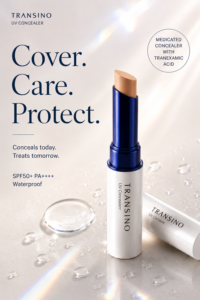
⚡ Quick Verdict: Who This Is For
This concealer is a good fit if:
- You want coverage that also actively works on the dark spots underneath
- You need SPF50+ PA++++ protection built into your coverage step — no separate sunscreen required for that area
- You need waterproof, sweat-resistant coverage that holds through a full day, indoors or out
- You prefer a pharmaceutical-grade (quasi-drug) product with substantiated efficacy claims, not just marketing language
- You have sensitive skin and need a fragrance-free, allergy-tested formula
Skip this if:
- Your concern is overall uneven tone rather than specific dark spots — a full-face brightening serum is better suited
- You need shade variety — this comes in a single multi-beige tone designed to blend across a range of complexions
- You’re looking for full-coverage foundation-level correction — this is a spot concealer, not a base product
💡 Texture & Feel: Stick Format, Natural Finish
The format is a lipstick-sized stick — the same shape as the TRANSINO Whitening Stick, but formulated for coverage and UV protection rather than skincare alone. It glides directly onto the spot, blends with a fingertip or brush, and sets without the cakey edge that cream concealers tend to leave around targeted areas.
Japanese reviews describe the texture as slightly firm but smooth on contact — enough resistance for precise application, enough slip to blend cleanly. The “しみラップ処方” (spot-wrap formula) is built to adhere specifically to the surface texture of pigmented areas, which tend to differ slightly from the skin around them. The “境目ぼかしパウダー” (edge-blurring powder) softens the line between covered and uncovered skin, which is the detail that determines whether spot coverage reads as concealed or just looks like a concealer.
The finish sits closer to natural than matte or dewy — it blends into skin rather than sitting on top of it. Used under powder foundation, it works as a pre-application concealer; over liquid or cream foundation, it layers on top. Which order makes sense depends on the base product in your routine.
The waterproofing is where it earns its keep day-to-day: coverage that survives a commute, a workout, or an afternoon outdoors without migrating is a low bar that a surprising number of concealers still fail to clear.
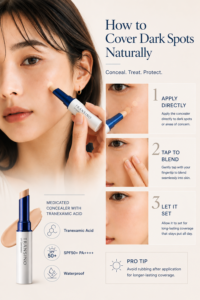
💪 Visible Effects: Coverage That Holds, Spots That Gradually Fade
The immediate effect is coverage — spots and uneven pigmentation disappear under the multi-beige tone, formulated to avoid pulling obviously pink or yellow across a range of complexions. The edge-blurring powder is what makes the difference between skin that reads as even and skin that reads as “something’s covering this.”
The waterproof performance is the detail most consistently flagged in Japanese platform reviews. Coverage that holds through a Tokyo summer commute, or a Singapore afternoon spent outdoors, without breaking down by evening is a meaningfully different experience from concealers that need a midday touch-up.
The longer-term effect is where the pharmaceutical background actually matters. Tranexamic acid works by blocking the melanin production signal, and that mechanism operates continuously during wear — not just at the moment of application. Reviewers using it consistently describe spots that become easier to cover over time, needing less product for the same result. That trajectory is the real difference between a concealer that treats and one that only covers.
Worth setting expectations on: results are gradual, not immediate. Tranexamic acid doesn’t visibly fade a spot within days — the mechanism needs weeks of consistent use to interrupt the melanin cycle meaningfully. If you’re expecting foundation-level instant correction, the pace will feel too slow. If you go in expecting coverage-plus-treatment, the cumulative result tends to land better than either category alone.
⚠️ Not the best fit if…
- You need dramatic full-coverage correction for deep or long-standing hyperpigmentation — dermatological consultation may be more appropriate
- You want immediate brightening rather than gradual treatment over weeks
- You need multiple shade options to match your exact skin tone
🧪 Ingredients: Why This Is a Quasi-Drug, Not Just a Concealer
The ingredient architecture reflects TRANSINO’s pharmaceutical origins — a medicated active at the center, supported by functional complexes chosen for the specific demands of daily spot coverage and UV exposure.
The BCO Complex is worth understanding in the context of daily city life. Peony, coptis, and scutellaria extracts aren’t primarily brightening agents — they’re there to offset the cumulative damage from UV and airborne pollutants like PM2.5, which both worsen existing pigmentation and speed up new spot formation. Applied daily in an urban environment, that protective function is running continuously alongside the coverage itself.
🗣️ Real Voices from Real Users
One reviewer with dry skin described the stick as firm but easy to dispense, noting that even after layering cream foundation on top, the covered area didn’t develop the dry patches she usually gets from concealer. She called that the deciding factor in repurchasing.
A reviewer in her late 50s with dry, sensitive skin said she’d avoided TRANSINO products for years, assuming the brand’s spot-treatment focus meant a drying formula. After trying the renewed essence formulation, she found it more wearable than expected and said she’d reconsider the rest of the lineup.
A more neutral review described it less as a concealer and more as a “brightening UV stick” — effective on faint spots, but only lightening (not fully hiding) deeper, more established pigmentation. She noted the slim stick shape made application easy regardless.
Reviews summarized and paraphrased from Japanese beauty review platforms.
❓ Common Questions About TRANSINO UV Concealer
Does this actually treat dark spots, or just hide them like every other concealer?
Both, by design. The medicated active (tranexamic acid) works on the melanin production process underneath while the formula covers the spot on the surface. It won’t replace a dedicated treatment serum for deep pigmentation, but it’s doing more than coverage alone — which is the gap most concealers don’t address.
Will this fully cover deep or long-standing dark spots?
Not entirely. Reviews consistently note it performs well on faint to moderate spots but only lightens — rather than fully hides — deeper, long-settled pigmentation. For more advanced concerns, pairing it with a treatment serum or a dermatologist consultation will get you further.
Can I wear this under or over foundation?
Either. Under powder foundation, it works as a pre-application spot treatment. Over liquid or cream foundation, it layers on top as a finishing step. Which order to use depends on your base product.
Is it actually waterproof, or just water-resistant in the usual marketing sense?
It carries Japan’s double-star UV water resistance rating, built for sweat and humidity rather than indoor-only wear. It’s not designed for swimming or full submersion, but daily heat and perspiration shouldn’t compromise the coverage.
How long before I see results on the spots themselves — not just the coverage?
The tranexamic acid works gradually and won’t visibly fade a spot within days. Reviewers who saw a real difference in their spots’ visibility over time had been using it consistently for several weeks — not as a one-time fix.
✨ Where to Buy TRANSINO UV Concealer
📌 Reference Price (Japan): around ¥2,430 at Japanese retail — a general benchmark only; actual prices vary by region and retailer.
📎 Reference
- Manufacturer: Daiichi Sankyo Healthcare Co., Ltd. — official product page
- User reviews summarized from Japanese beauty review platforms
- This article reflects independent research and editorial judgment. The product was not provided by the manufacturer for review, and this post contains affiliate links.


コメント